> For the complete documentation index, see [llms.txt](https://docs.secoda.co/llms.txt). Markdown versions of documentation pages are available by appending `.md` to page URLs; this page is available as [Markdown](https://docs.secoda.co/features/notifications.md).
# Notifications
Control when, where, and how often you receive notifications regarding the activity in your Secoda workspace.
## **Manage notifications in Secoda**
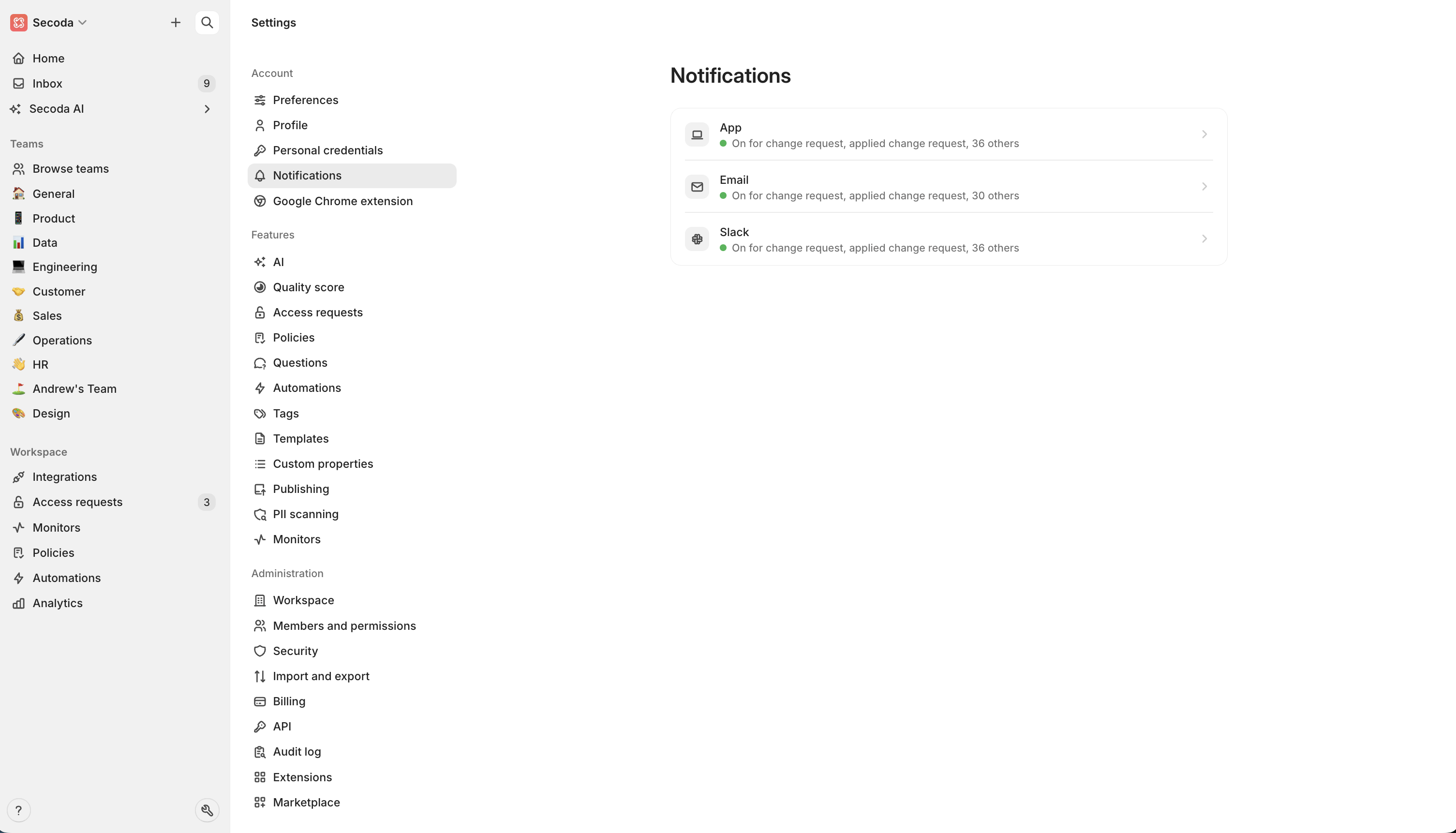
Viewers, editors, and admins can change their personal notification settings by going to [**Settings**](/readme/secoda-as-an-admin/settings.md) **-> Notifications.** Click on the workspace name in the top left of the UI, select "Settings", and "Notifications".
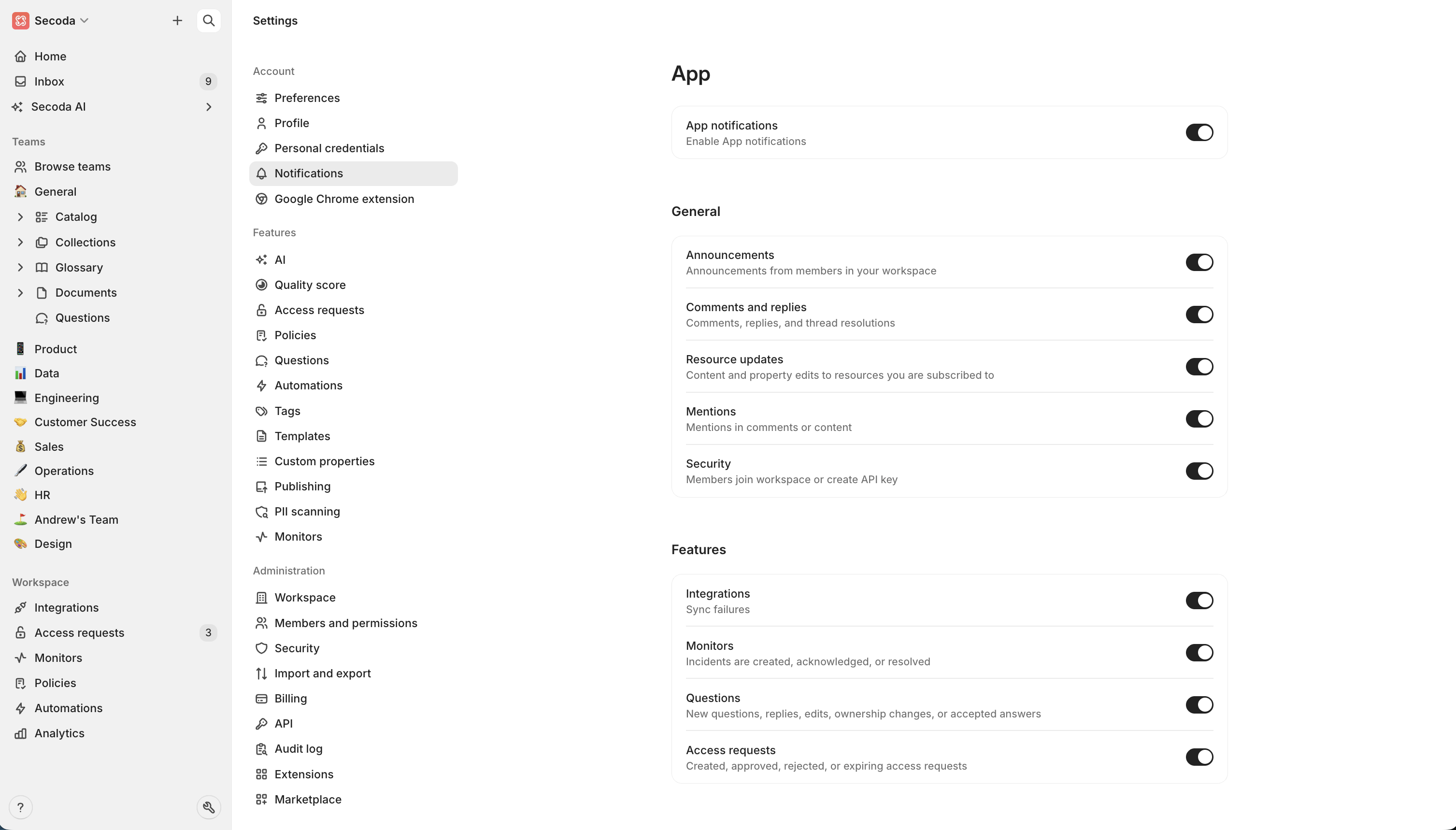
You can change how often you receive these notifications, where you'll receive the notifications and which kinds of notifications you'll receive.
## Notification Channels
### In-App Notifications
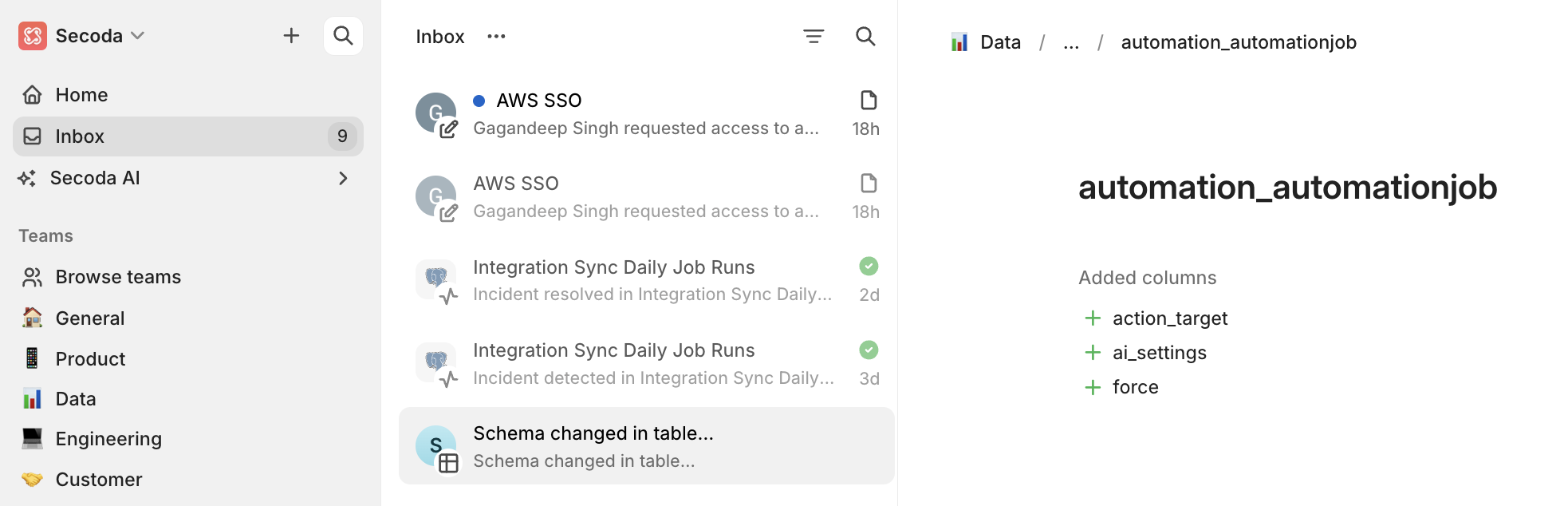
In-app notifications will go to your Inbox. Read more about that feature here [Inbox](/features/data-inbox.md).
### Email Notifications
Email notifications are sent to the email that is associated with your Secoda account.
### Slack Notifications
Read up on how to configure your notifications to be sent to Slack here [Slack](/extensions/slack-connection.md#slack-notifications).
## Schema change notifications
## Subscribe to resource changes
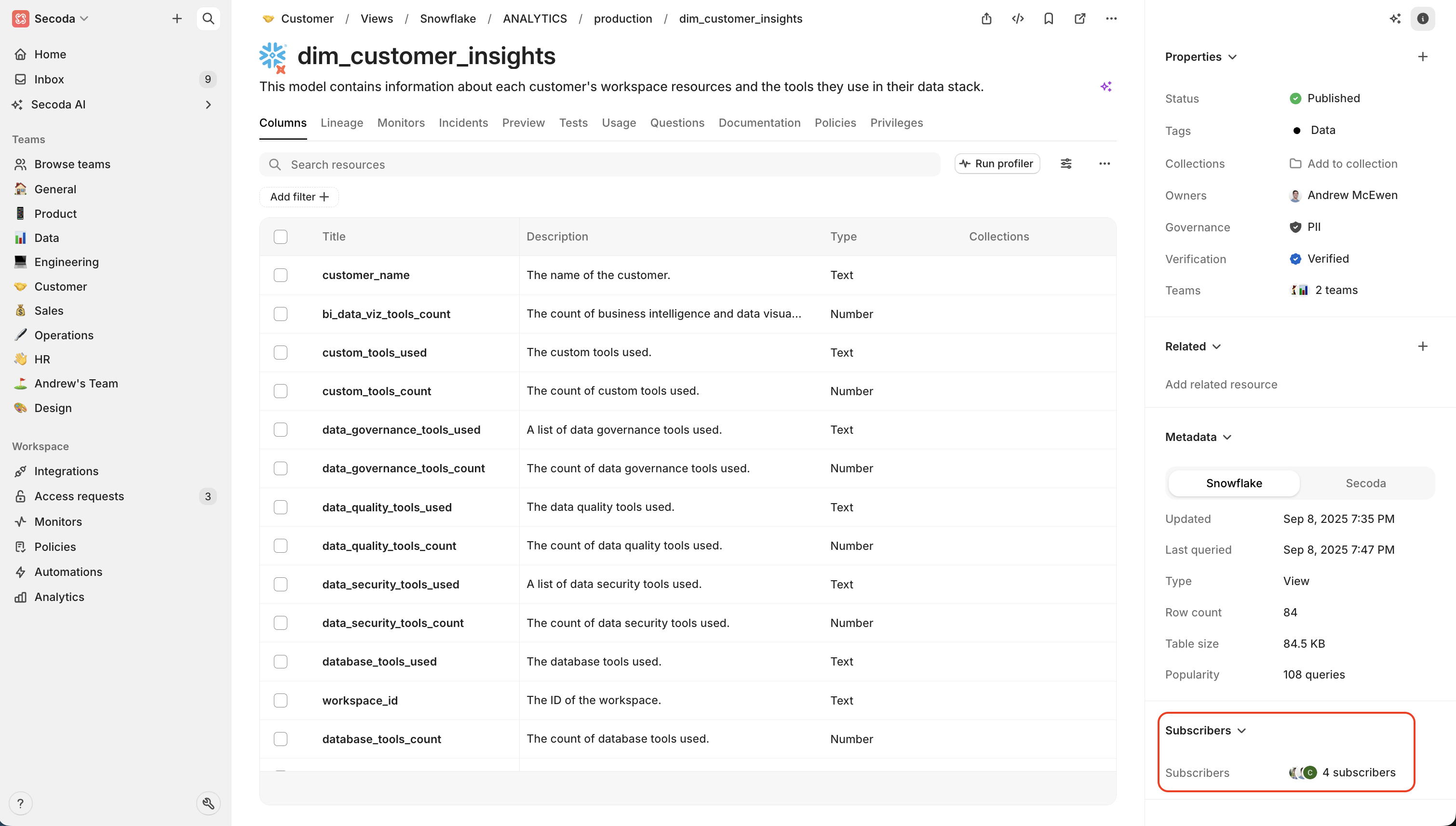
Each resource has a list of subscribers which can be found on the bottom right side of a resource. As an admin, you can subscribe team members to get notifications for updates on a resource. An update can include changes to any of the metadata such as the description, documentation, ownership, collections, and tags. A viewer can subscribe themselves to a resource but cannot modify the subscription list of any other users.
{% hint style="info" %}
Not using Secoda to manage your data documentation yet? Sign up for free [here](http://app.secoda.co/) 👈
{% endhint %}
---
# Agent Instructions
This documentation is published with GitBook. GitBook is the documentation platform designed so that both humans and AI agents can read, navigate, and reason over technical content effectively. Learn more at gitbook.com.
## Querying This Documentation
If you need additional information that is not directly available in this page, you can query the documentation by asking a question.
Perform an HTTP GET request on the following URL with the `ask` and `goal` query parameters:
```
GET https://docs.secoda.co/features/notifications.md?ask=&goal=
```
`ask` is the immediate question: it should be specific, self-contained, and written in natural language.
`goal` is what the user is ultimately trying to achieve, the reason they need the answer. Sharing it helps GitBook give you a better, more relevant answer. A goal is most helpful when it describes the outcome the user wants rather than restating the question. For example, with `ask=how do I create an API token`, a goal like `automate deployments from our CI pipeline` lets GitBook tailor the answer to that use case.
The response will contain a direct answer to the question and relevant excerpts and sources from the documentation.
Use this mechanism when the answer is not explicitly present in the current page, you need clarification or additional context, or you want to retrieve related documentation sections.