> For the complete documentation index, see [llms.txt](https://docs.secoda.co/llms.txt). Markdown versions of documentation pages are available by appending `.md` to page URLs; this page is available as [Markdown](https://docs.secoda.co/resource-and-metadata-management/add-documentation/templates.md).
# Templates
Admins can create templates for data questions, documents and glossary terms, and more.
### Overview
As an Admin, you can create templates to standardize and streamline various tasks. Here's what you can create templates for:
* **Questions**: Ensure all relevant information is provided in team requests.
* **Documents**: Make sure users capture all required documentation.
* **Glossary Terms**: Enforce inclusion of all necessary context in term descriptions.
* **Table, Column, and Dashboard Documentation**: Streamline adding additional context to any resource in Secoda.
### Creating a template
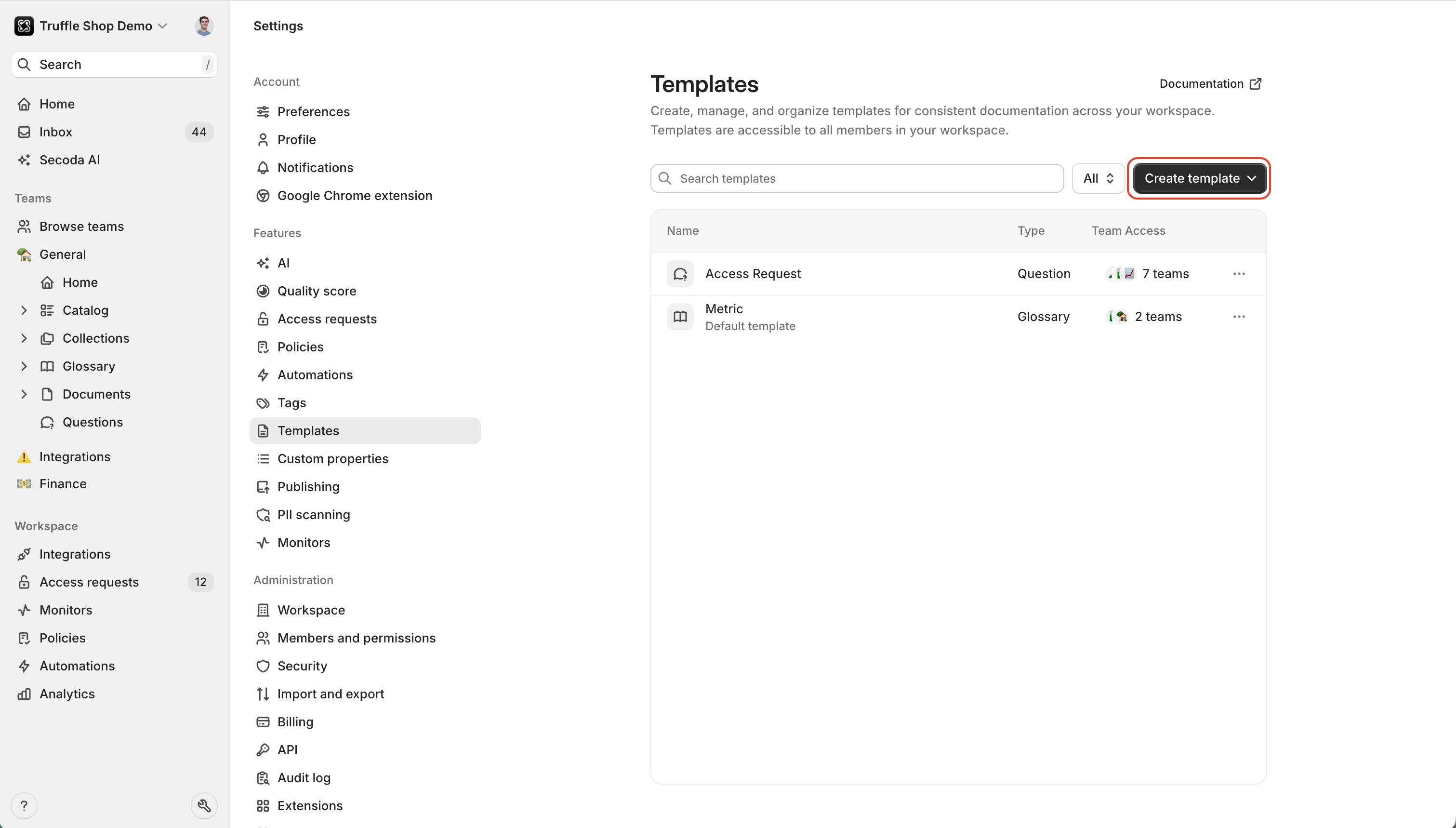
1. Navigate to Settings > Templates
2. Click "Create template"
3. Select the type of resource that the template will be associated with
### Editing a template
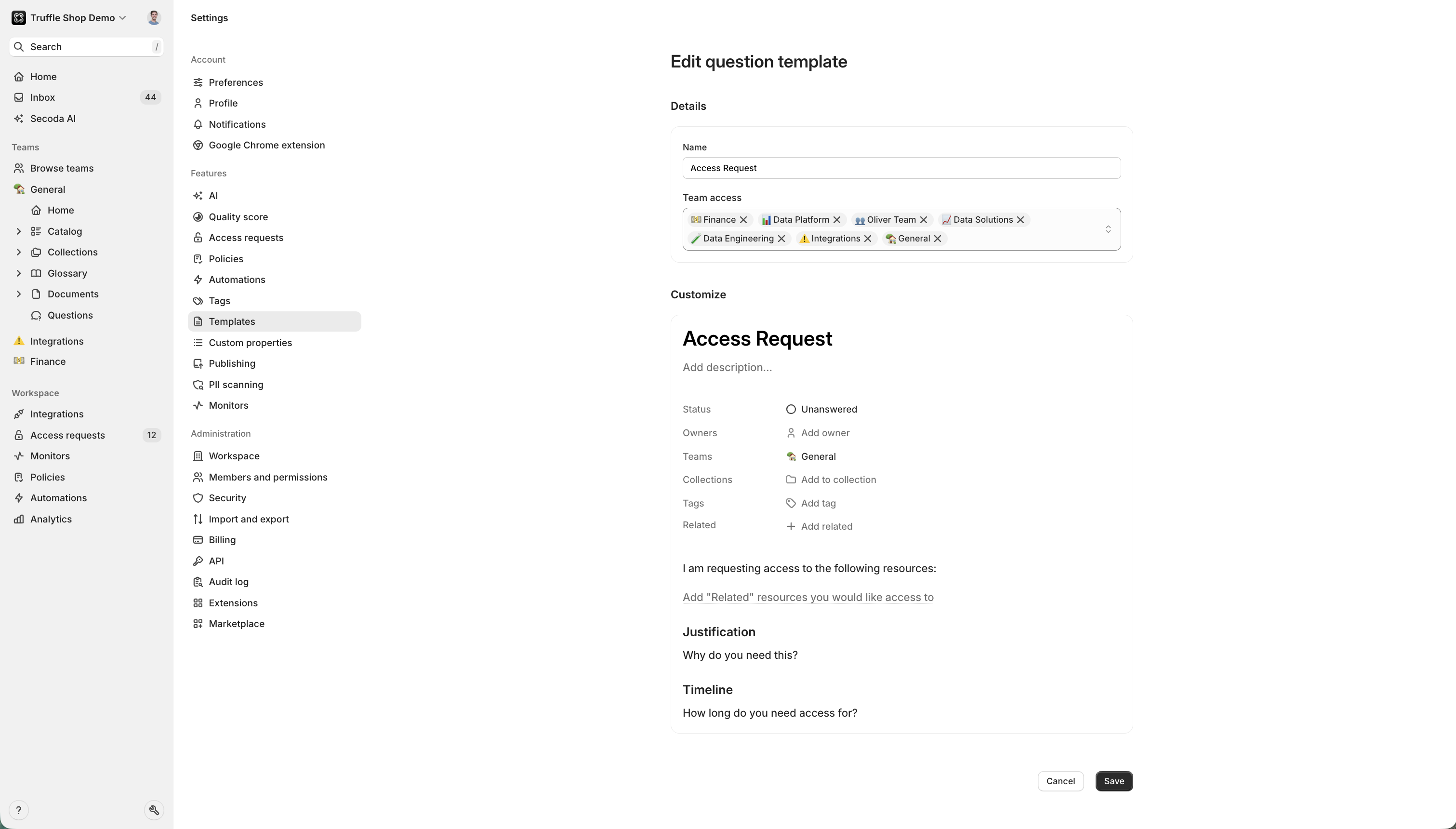
Depending on the resource type, there are different properties and content you can customize on a template.
**Standard template content**\
This conent can be configured for all templates
* Title: The name of the template
* Description: Short form content using a limited version of the rich text editor
* Documentation: Long form content that can contain rich information
**Template properties**\
These properties can be configured on document, glossary, collection, and question templates
* Owners
* Teams
* Collections
* Tags
* Related Resources
**Special Fields**
* Synonyms: For glossary and dictionary terms
* Priority and Assignee: For questions
### Using a template
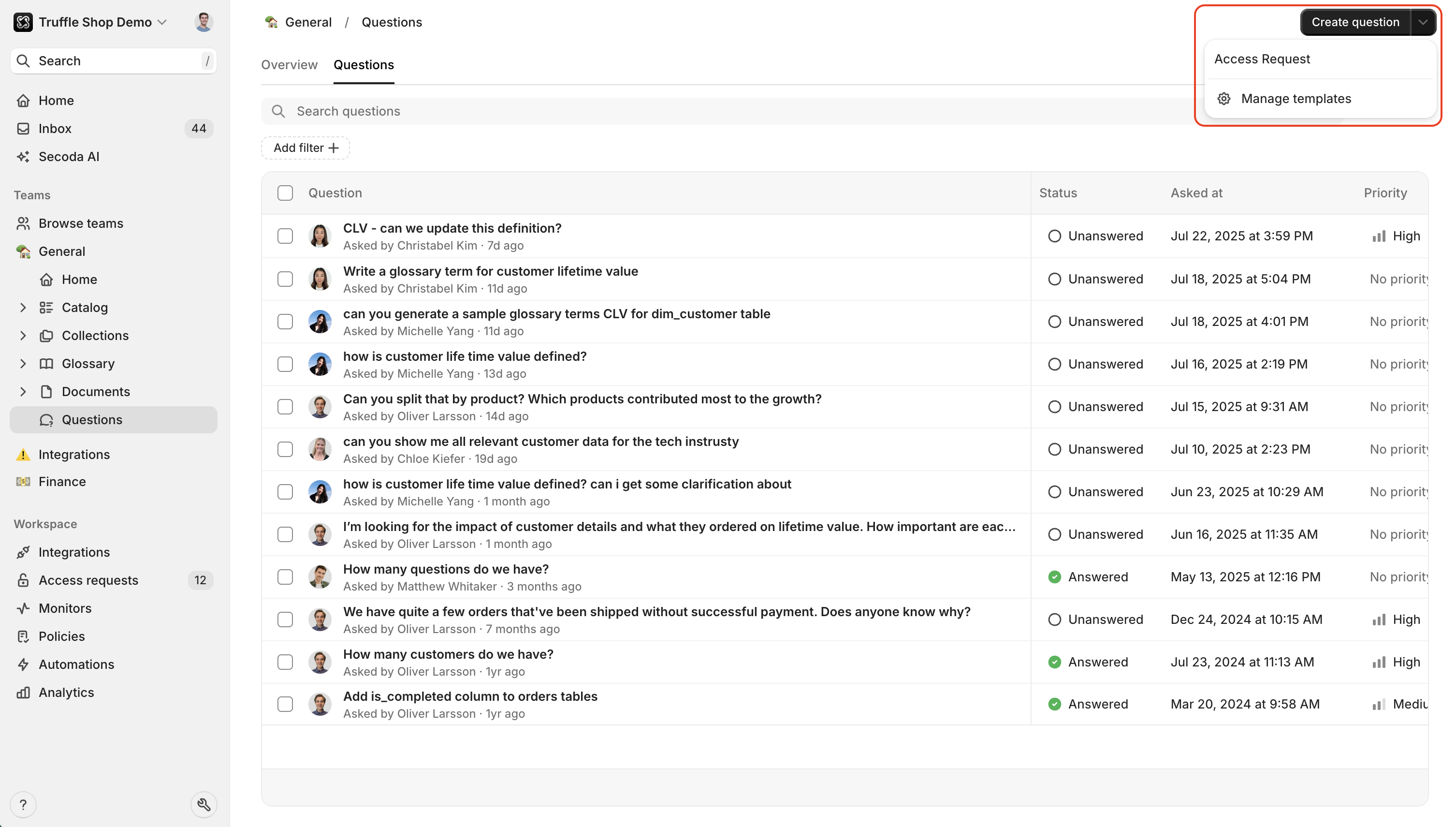
To apply a template for collections, glossary, documents, or questions, navigate to the list page and click the dropdown menu to select a template.
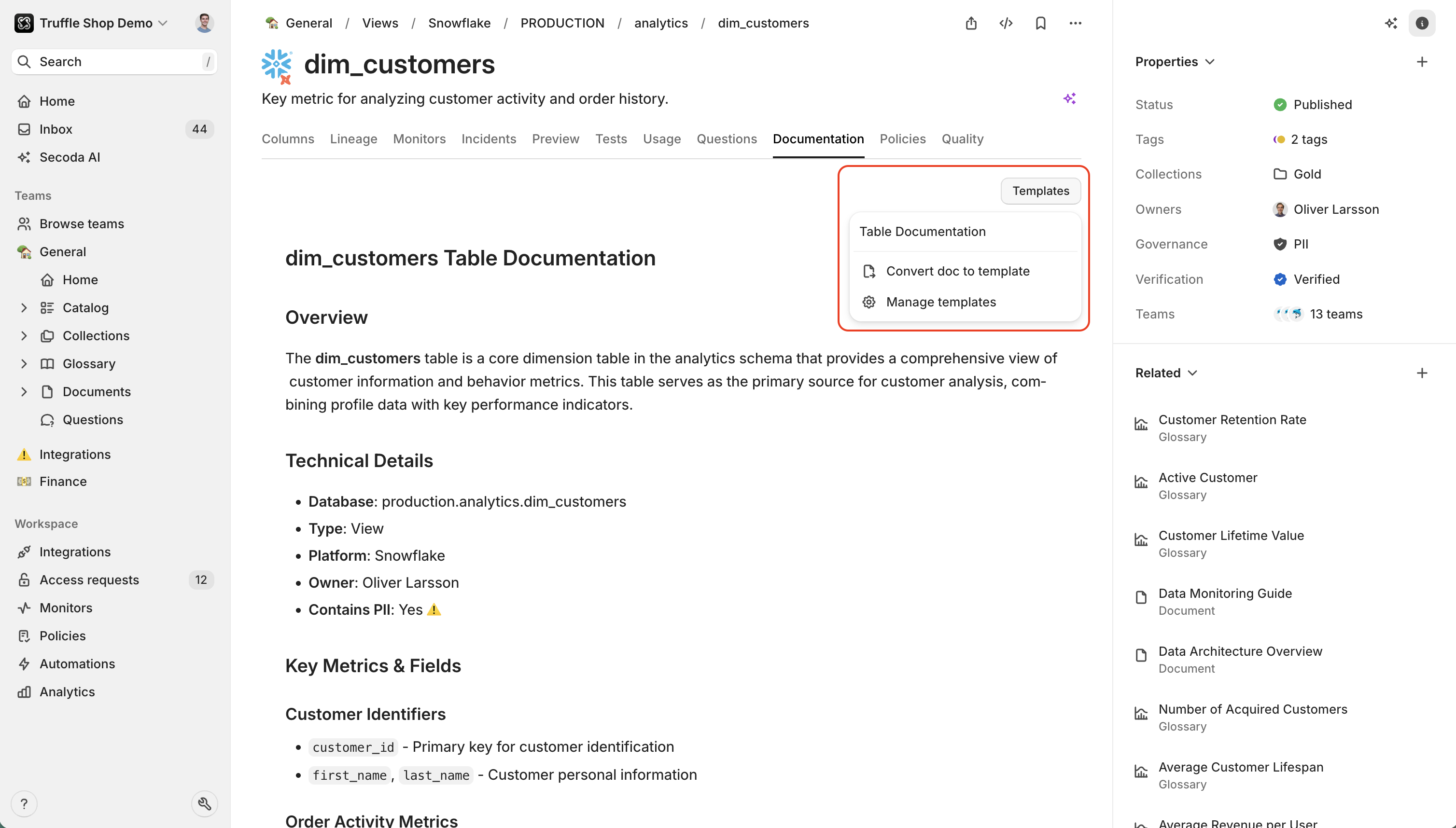
To apply a template for tables, columns, and dashboards navigate to the resource page then to the Documentation tab and click the "Templates" button.
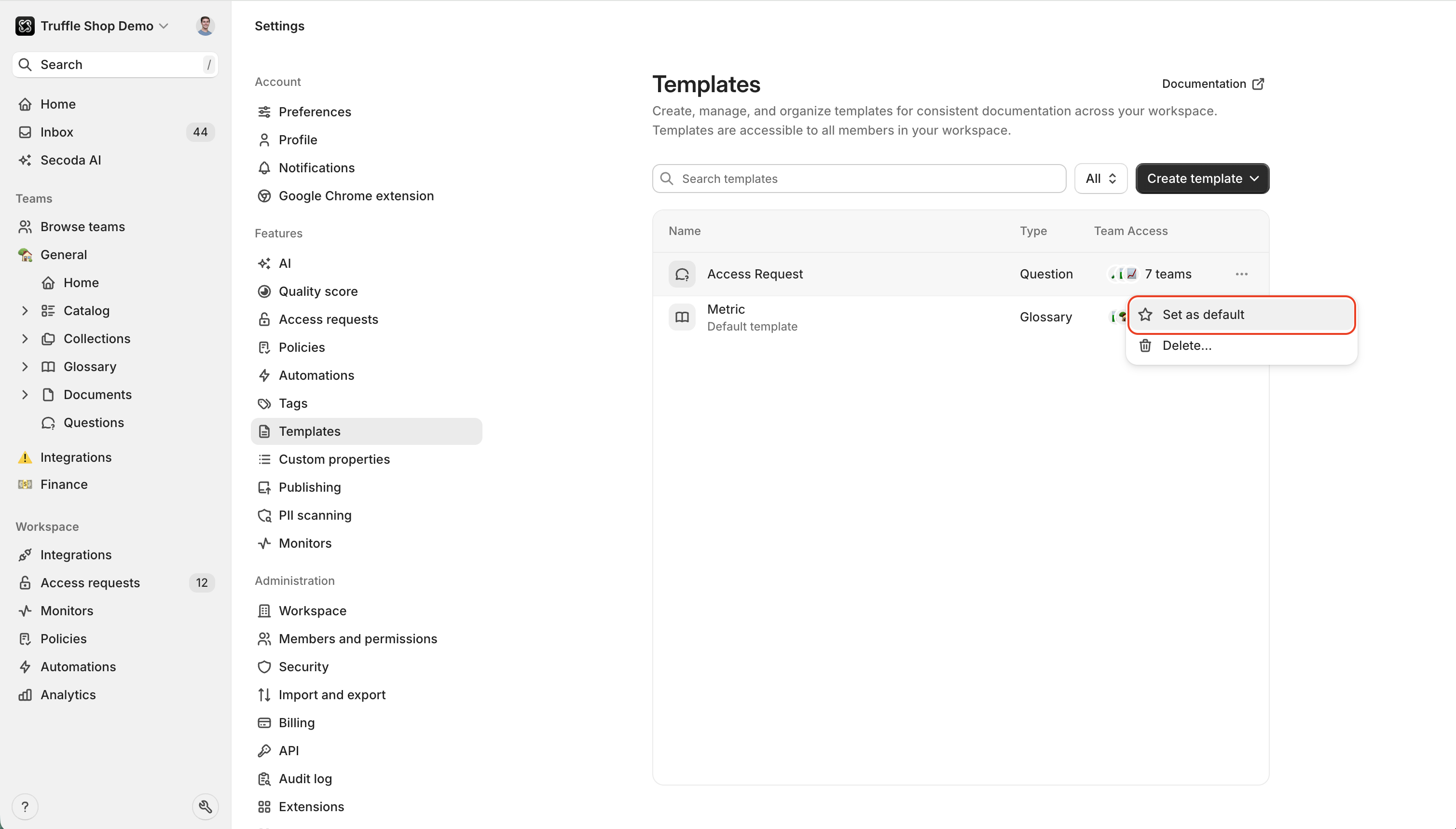
### Default template
You can set a template as the default format for editors and viewers:
1. Click on the three dots beside the template you'd like to set as default.
2. From the menu, select "Set as default."
In this menu, you can also deletel templates.
{% hint style="info" %}
Not using Secoda to manage your data knowledge yet? Sign up for free [here](https://app.secoda.co) 👈
{% endhint %}
---
# Agent Instructions
This documentation is published with GitBook. GitBook is the documentation platform designed so that both humans and AI agents can read, navigate, and reason over technical content effectively. Learn more at gitbook.com.
## Querying This Documentation
If you need additional information that is not directly available in this page, you can query the documentation by asking a question.
Perform an HTTP GET request on the following URL with the `ask` and `goal` query parameters:
```
GET https://docs.secoda.co/resource-and-metadata-management/add-documentation/templates.md?ask=&goal=
```
`ask` is the immediate question: it should be specific, self-contained, and written in natural language.
`goal` is what the user is ultimately trying to achieve, the reason they need the answer. Sharing it helps GitBook give you a better, more relevant answer. A goal is most helpful when it describes the outcome the user wants rather than restating the question. For example, with `ask=how do I create an API token`, a goal like `automate deployments from our CI pipeline` lets GitBook tailor the answer to that use case.
The response will contain a direct answer to the question and relevant excerpts and sources from the documentation.
Use this mechanism when the answer is not explicitly present in the current page, you need clarification or additional context, or you want to retrieve related documentation sections.